
Issue 42
The Case for Quitting

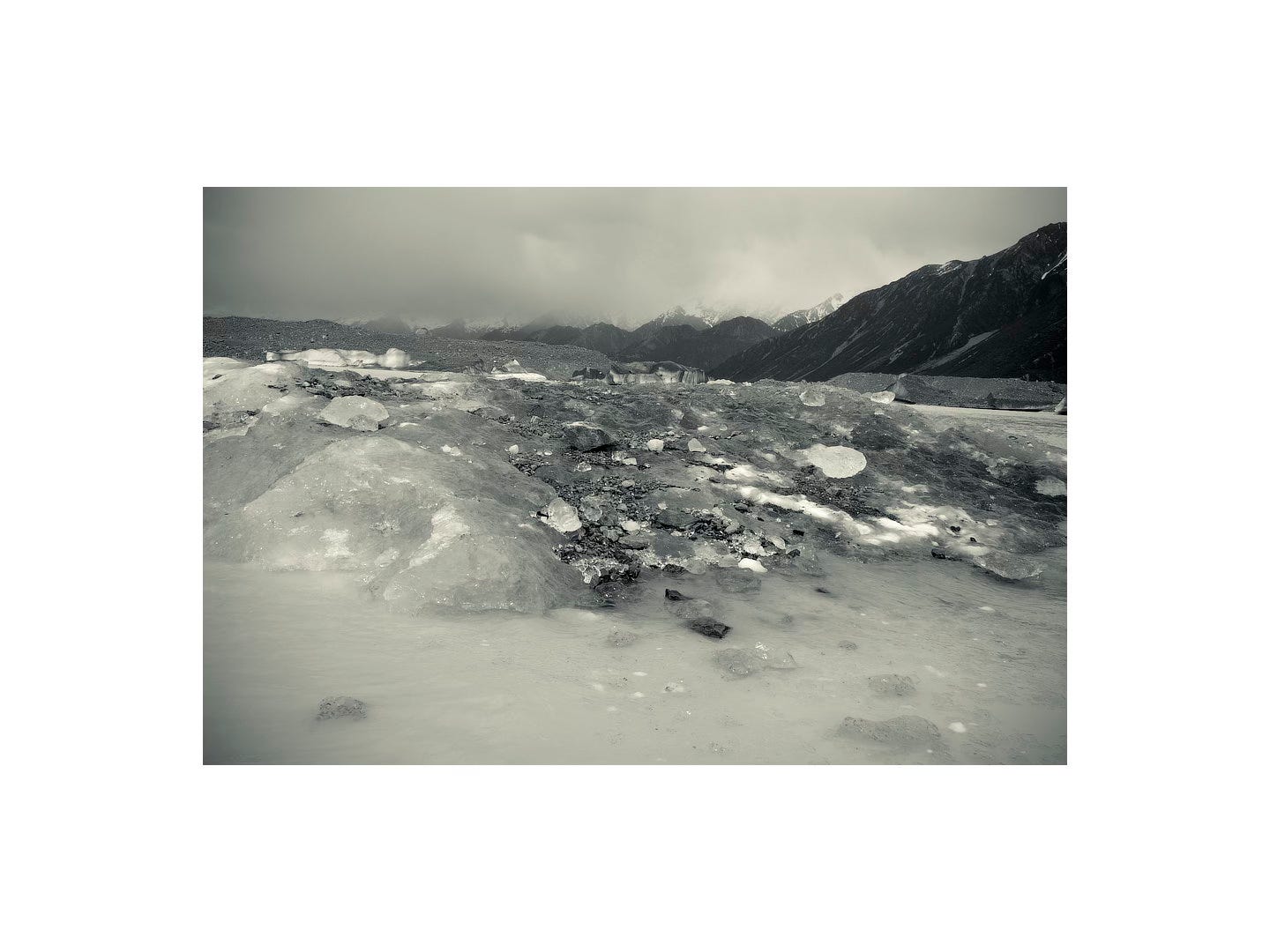
There is a particular kind of terrain that preoccupies me: the edge zone. The place where a glacier has recently retreated, leaving behind raw moraine — gravel and silt and cold light. Ecologists call what follows primary succession. The land doesn’t restore itself. It becomes something else entirely.
I have been thinking about this as I think about quitting.
Western culture has built a theology around persistence. Grit. Staying the course. The billionaire’s memoir is always, at its core, a story of not stopping — though it rarely mentions what was sacrificed at the altar of the not-stopping, or who else bore the cost. The assumption embedded in this theology is worth examining: that the self who began a thing is the same self who must finish it. That identity is fixed. That what you valued at thirty will be what you value at forty-five.
The moraine disagrees. So do I.
Identity is not a static formation. It shifts with experience, with accumulating understanding of who we actually are — as opposed to who we once hoped we might be. The decision that was optimal five years ago may no longer be. This is not failure. It is information. The question is whether we are honest enough to acknowledge it.
Economists have a clean solution for this problem, as economists often do. Ignore sunk costs, they say. What you have already spent — in time, money, prestige, or the bruised years of your early forties — is gone regardless of what you decide now. What matters is the realistic expected value of continuing, measured against the realistic expected value of the alternatives. Every hour on one path is an hour not spent on another. Your past self is not a reliable advisor for your future self. He has too much at stake.
But I am not a calculating machine, and neither are you. We are creatures who feel the weight of what we have invested. The sunk cost is not just an accounting error; it is a grief. And grief is not easily ignored.
“you must go on, I can’t go on, I’ll go on.” — Samuel Beckett, The Unnamable
One way through is to resist the seduction of the exceptional outcome. In certain fields — art among them — no result is ever out of reach. There is always the next show, the next series, the residency that changes everything, the collector who finally sees it. This open-endedness is one of the things that makes creative work meaningful. It is also what makes it a particularly efficient trap.
The honest exercise is to consider not your best possible outcome, but your average one. The distribution of results across people doing what you are doing, working as hard as you are working. Averages are not destiny. But they are a corrective to the story we tell ourselves about our own exceptionalism — a story that keeps us at the table long after the odds have turned.
The signals are usually legible before we are ready to read them. I have learnt to pay attention to a particular cluster: time spent on work that funds the work I want to do, rather than on the work itself. Flagging enthusiasm that is not tiredness. Goals that have quietly shifted.
These are not reasons to panic. They are readings. Take them seriously.
“Winners quit fast, quit often, and quit without guilt.” — Seth Godin, The Dip
When I have decided to leave something, I have come to believe in a particular discipline: decide quickly, move slowly. The decision, once made, should not be relitigated every morning. But the execution — particularly when others have woven their plans around yours — deserves care. Sometimes the situation doesn’t allow for that. Sometimes the exit has to be sudden. But where there is space for a coherent leaving, use it.
There is also the question of what follows. Quitting one thing does not automatically open into another. Skills are not perfectly transferable; the gap between what you were and what you are becoming is real, and sometimes expensive — a pay cut, a loss of standing, a period of feeling junior again in your own life. This friction is not trivial. It is one of the reasons people remain in unsatisfying work for longer than serves them.
One approach that helps: arrive somewhere before you leave. The bridge takes time to build — more than you’d like — but it narrows the gap between the self who is departing and the self who hasn’t quite taken shape yet.
This issue is, in part, a note about my own leaving.
For the past several years, street photography was my primary practice — five years in Rome, London, Lisbon, New York. I photographed strangers before I had learned not to be afraid of them. The streets taught me that. They were the bridge.
Earlier this year I wrote that I was shifting my practice toward something different: essays rooted in environmental and human narratives, exploring how people and places live with change and uncertainty. The work I am now making under Margins of Safety — landscapes of risk, restraint, and decision — is where that shift has led me.
My reasons were not strategic. They were a matter of values. What I wanted to say had outgrown the form I had been using to say it.
If that is not what you subscribed for, I understand the impulse to leave quickly and without ceremony. There are worse applications of this issue’s advice.
But if you stay: the core of this letter has not changed. I will still write about creative life and process. I will still share images. Only the terrain has changed.
What would you gain if you stopped?