
Issue 44
Doing the Reps

One or Two Quotes
I
|Confidence is the successful repetition of any endeavour. Courage is the birthplace of confidence.”
— Debbie Millman
II
“We don’t rise to the level of our expectations, we fall to the level of our training.”
— Archilochus
Ideas for the Creative Mind
I
Years ago I switched from analogue photography to digital. Not for love. For logistics.
Analogue had fallen out of favour, and finding a lab that could handle the full chain — development to print — competently was becoming difficult.
II
For a while I managed by doing much of it myself. But running a darkroom takes space, and hiring space is expensive unless you’re an established artist with enough volume to justify the cost.
I adopted a hybrid chain: scan the negatives, print them using an archival inkjet process. When the scanner was destroyed after one too many house moves, replacing it proved nearly impossible.
III
The real difficulty, though, was technical. I had become obsessed with processing and printing high-contrast negatives — pushing the boundaries of what the medium could hold in an attempt to make work that matched what I saw. No remaining lab offered this service. Doing it yourself required specialist chemicals, often hard to source, and trial and error in quantities that would test anyone’s patience.
A digital ecosystem solved most of these problems at modest cost.
In the Spotlight
I no longer travel constantly, which has given me something I didn’t have before: time to reconsider.
Image science has also moved on. I can now buy ready-made two-bath film developers that extract a far greater tonal range from a negative than anything I could mix a decade ago.
I intend to shoot most of Margins of Safety on a mix of black-and-white and colour film. Edge zones lend themselves to the former; colour brings something irreplaceable to the reportage side of the work.
To do this properly I need an analogue image chain I trust to deliver quality prints to collectors. The foundation, as always, is a negative that expresses the vision — and then a proof print good enough to make informed decisions for large-scale work.
Every week I work on a section of this chain. Last week: test prints — the stage before the proof.
For practice I chose the most difficult negatives I have ever made: four rolls of 6×7 black-and-white shot at Mt Kōyasan, Japan, in the dead of winter. Three feet of snow, ancient forests, cedar monuments — a tonal range stretched across fourteen stops of light.
After a marathon session with variable-contrast paper and split-grade printing, I arrived at this less-than-satisfying example — the subject of this week’s spotlight.
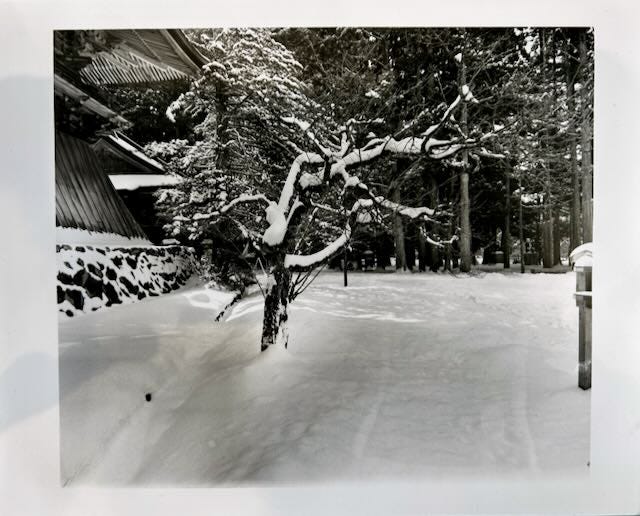
I start intuitively, as always. Wrestling with the problem teaches me what different techniques offer and where they fail. The difficulty with this negative is a tonal range greater than the printable spectrum. Trade-offs are unavoidable.
For the first round I wanted to see what happened when I tamed the highlights. I used a grade 1 filter on the forest and grade 2 on the snow. The result: too dark. Much of the detail in the snow has been lost.
Next week, two tracks. First: drop the base exposure to grade 0 — possibly 00 — then burn the forest at grade 2 or 3. Second: pre-flash the paper. Both should open up the tonal range. The question is what I sacrifice in the shadows.
The third round will introduce a two-solution developer alongside whatever worked best from the first two attempts.
This is how I build confidence. I do the reps — sometimes an unreasonable number of them.
A Question for You
What is the one thing you could do in five minutes — or fifteen, or thirty — to move your practice forward? When *the other* part of my life crowds in, I answer that question using a window of two.
— Johan du Preez