

One or Two Quotes
I
“Immature poets imitate; mature poets steal; bad poets deface what they take, and good poets make it into something better, or at least something different.”
— T.S. Eliot, The Sacred Wood (1920)
II
“In place of a hermeneutics we need an erotics of art.”
— Susan Sontag, Against Interpretation (1966)
In the Spotlight
Three Ideas for the Creative Mind
I have no formal art education.
This perceived handicap is more than compensated by ravenous curiosity hardwired into my DNA. I don’t just read or watch; I devour — books, photographs, paintings, architecture, composition, light, colour and (intelligent) conversations.
Through this conscious theft I collect ideas but keep only those that align with my practice lest they choke my creativity like weeds in an unkempt garden.
I
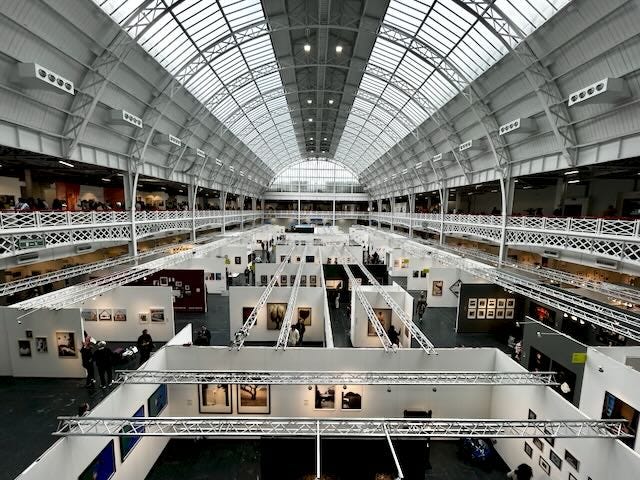
This year Photo London showcased work from 131 galleries and publishers. One would expect there to be something for every taste. But that is not how a market works, particularly one skewed by perceptions of value that only time can test.
Curators display what they think they can sell. In other words, work for which they anticipate demand, their view formed by information gleaned from enquiries, press clippings and conversations. However, like most marketplaces, these beliefs can become self-reinforcing and coalesce around a theme.
A few years ago I found the nude on almost every wall. This year the theme has shifted to stories about people and place, with figurative work and nature hardly making an appearance.
II
In this context, Ragnar Axelsson, Luis Morales and Michael Kenna’s environmental and landscape prints drew me in.
Luis’s work, focusing on space and its relationship with the humans who occupy it, was exemplified by Litoral, a large-scale impressionistic image of beach life. The sky and beach — both uniformly toned in complementary hues — act as visual anchors that inexorably draw the eye to the life playing out in miniature in the middle ground. Figures — in various stages of undress, arrival, departure or rest — transformed the space into one of leisure that could be almost anywhere.
Michael Kenna’s prints are finely crafted studies of the interaction between nature and human structures. Whilst not abstract in the literal sense, they focus on fine details by smoothing over the tonality of broad planes and using these as anchors or leading lines. What stunned me was that these beautifully crafted prints are all from a traditional black-and-white darkroom. Whilst his focus on light at dawn, dusk and night is at odds with my own, his prints are masterpieces of restraint and the use of negative space to emphasise his message.
Ragnar’s work is beautiful, evocative and harsh. That he manages to capture the stark beauty of the Arctic landscape and its people is a testimony to the years he has spent in this formidable landscape. Whilst his work does not flinch at the perils of global warming, it is hauntingly beautiful. This proves that a body of work with a conservation message can be uplifting.
III
In the publishing section I saw only a few books with a clear nature theme. Ready to give up and head home, I was revitalised by Case Publishing, Tokyo, which had so many beautiful nature-themed books on offer. I was particularly taken by the work of Toshiki Nakanishi, whose work in and around the Daisetsuzan mountain range drew my attention. Not only are his prints evocative, fine exemplars of the craft, but they are clearly at odds with a long Japanese tradition of containing nature: aestheticised, framed and reduced to scale.[1]
Having procured a copy of New Land — Pre-Hokkaido Landscapes, I hope to spend time with Nakanishi’s work and splice its nuance into the DNA of my creativity to elevate my own work.
Closing Thought
I am not discouraged by the lack of conservation-oriented work on offer in the UK. A contrarian by design, I understand the value of a long-term focus on difficult problems the human mind prefers to ignore in favour of quick wins.
— Johan du Preez
Notes
See for example Arne Kalland, Pamela Asquith, Julia Adeney Thomas and Augustin Berque.↩︎